How we do AI at AgentScore
One version-controlled brain every teammate and AI tool reads, plus agents your team works with in Slack. How a small team moves without knowledge silos.
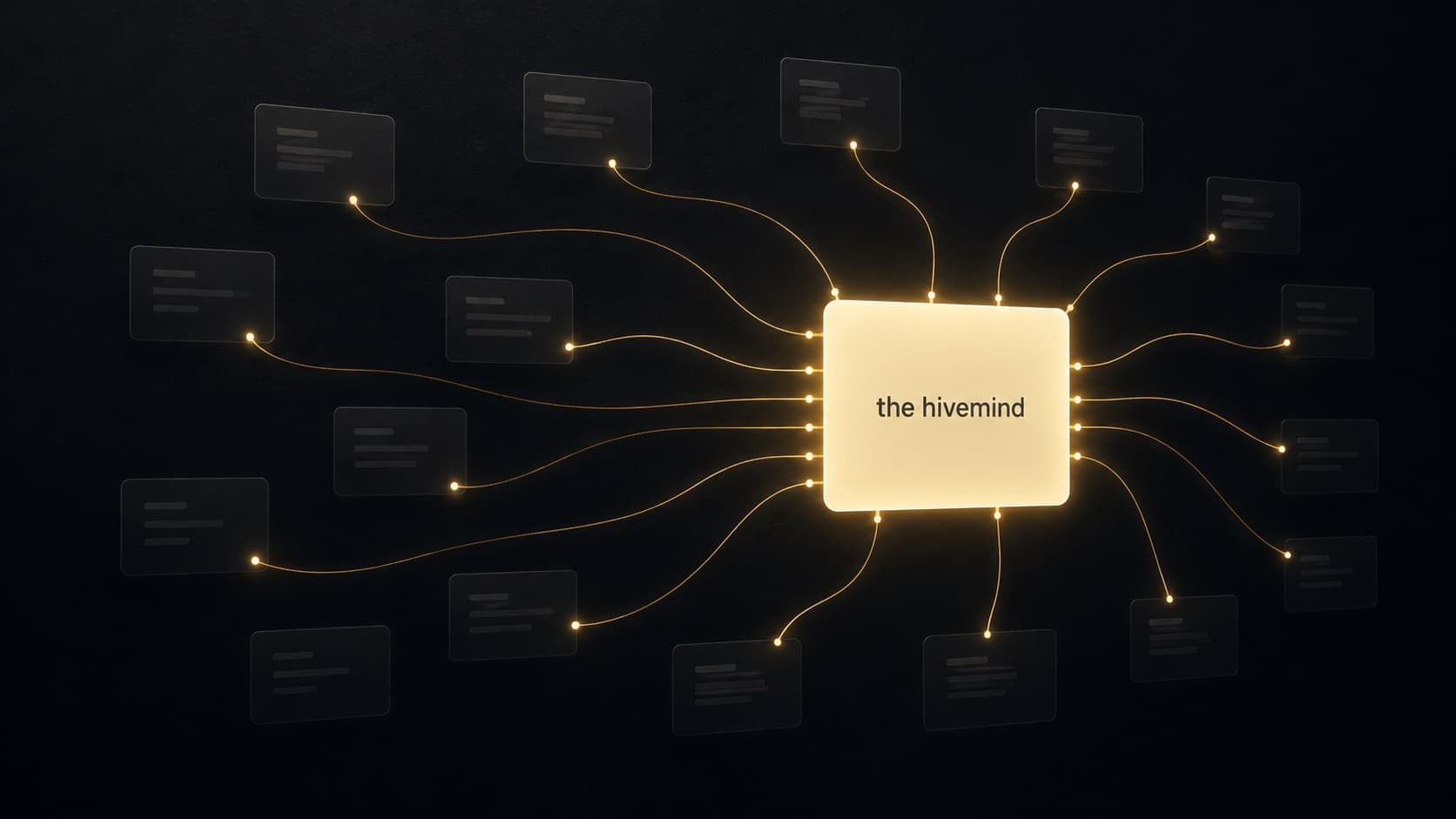
Most companies keep their knowledge in a dozen places. A wiki that is half current. A few pinned Slack threads. A doc someone wrote a year ago. The rest lives in three people's heads. It holds together until you grow, or until you start handing real work to AI.
Here is the part nobody warns you about when you adopt AI: every tool you bring in, the coding agent, the writing assistant, the research assistant, is only as good as the context you give it. Most teams hand each one a different, partial, slightly stale slice of how the company actually works. So the tools inherit the silos. You end up with five assistants that each know four-fifths of the story, and none of them agree. The cost of getting this wrong is not abstract: Gartner expects organizations to abandon 60% of their AI projects through 2026 for lack of AI-ready data. Getting that context right is becoming its own discipline; some now call it context engineering.
Andrej Karpathy
@karpathy
People associate prompts with short task descriptions you'd give an LLM in your day-to-day use. When in every industrial-strength LLM app, context engineering is the delicate art and science of filling the context window with just the right information for the next step. Science because doing this right involves task descriptions and explanations, few shot examples, RAG, related (possibly multimodal) data, tools, state and history, compacting... Too little or of the wrong form and the LLM doesn't have the right context for optimal performance. Too much or too irrelevant and the LLM costs might go up and performance might come down. Doing this well is highly non-trivial. And art because of the guiding intuition around LLM psychology of people spirits.
On top of context engineering itself, an LLM app has to:
- break up problems just right into control flows
- pack the context windows just right
- dispatch calls to LLMs of the right kind and capability
- handle generation-verification UIUX flows
- a lot more - guardrails, security, evals, parallelism, prefetching, ...
So context engineering is just one small piece of an emerging thick layer of non-trivial software that coordinates individual LLM calls (and a lot more) into full LLM apps. The term "ChatGPT wrapper" is tired and really, really wrong.
June 2025
At AgentScore we took the opposite bet. We run the whole company on a single shared brain we call the hivemind: one version-controlled root that every person reads and every AI tool loads automatically. Same brain for a new hire in sales, a senior engineer, and the agent drafting a docs page. It is how a small team ships across identity, payments, and compliance without drowning in "wait, where is that written down."
The one rule that makes it work
Every document points to the canonical source for a thing instead of restating it. One place owns brand voice. One place owns the deploy process. One place owns who is live. Nothing goes stale, because nothing is duplicated.
The problem is not "we need a wiki"
Plenty of teams have a wiki. The problem is that a wiki is built for people, and now half your workforce is software. The rules that actually matter, how we write, what we never say in public, why we chose one rail over another, which dependency is pinned and why, have to be legible to a human reading on day one and to an agent picking up a task at 2am. When those live in different formats in different tools, you maintain them twice and they drift.
| The hivemind | The usual setup | |
|---|---|---|
| Where the rules live | One version-controlled root | Wiki + Slack + a few heads |
| New teammate, hour one | Same brain the senior team uses | Weeks of asking around |
| What your AI tools know | Every tool loads the same brain | Each tool gets a different, partial prompt |
| When a rule changes | Change once, everyone inherits | Update N places, hope they sync |
| Agent output | Already on-brand and compliant | Re-reviewed from scratch every time |
One brain, wired into everything
The hivemind is a private repo of plain markdown: mission and positioning, brand voice and writing rules, the design system, engineering conventions and footguns, who is live and what they asked for, the decisions we made and why. It is organized by team, so a salesperson and a designer each start in the section that matters to them, under one set of shared rules.
The part that changes the day-to-day is that it loads into the AI tools natively. Whatever a person reaches for, a coding agent, an editor assistant, a CLI, picks up the same context with no copy-paste and no per-tool prompt babysitting. The brain is not a place you go look things up. It is the default context every tool already has.
It rides along in Claude Code and Codex
This is where it gets concrete for the people building. Our engineers live in coding agents, Claude Code, Codex, and the rest. One command wires the hivemind into all of them. After that, opening a coding agent in any of our repos means it already knows the company: the voice, the conventions, the things we never ship in public, the dependency we hold back and why.
It is layered. The org-wide brain loads on top, and each repo carries its own architecture of record that the agent reads when you work in that repo. So the agent shows up with both the company's standards and that codebase's specific shape, before you type a word. Tools that read a project file natively, Codex, Cursor, Gemini CLI, pick up the org rules the same way, through AGENTS.md, an open format a growing list of coding agents now read. Ask any of them to write a release note or a docs page and it comes back already following the rules a human reviewer would otherwise have to enforce by hand. And the brain is not limited to tools that read files: it is also served over MCP, read-only, so Claude on the desktop, Cursor, or any MCP client reads the same curated docs with the same access token, and every read lands in the audit log. The review stops being "fix the voice and the terminology" and becomes "is this correct."
You just ask it in Slack
This is the part that makes people lean in.
A new teammate, any role, opens Slack and DMs Queen Bee: "where do I find our pricing?" "how are we supposed to write?" "what's the deploy process?" It answers from the hivemind, with the canonical source, in seconds. Not a guess, not a stale screenshot, the actual current answer the founders would give. Every factual answer ends with a source line naming the exact doc it came from, and that is enforced, not encouraged: a test suite fails any agent that cites a doc it did not actually read. Day one, you have the whole company's memory in a chat box.
The same brain that governs our people governs our agents. We do not write the rules twice.
It does not stop at questions. We build our internal agents on eve, Vercel's open-source framework for building agents. eve is filesystem-first: an agent's skills are markdown files loaded on demand, so we point those skills straight at the hivemind. Every agent reads the same brain the humans do, and every agent works the same way. It drafts; it does not publish. It opens a pull request, or drops a draft in a Slack channel with an approve button, and a human decides. Nothing ships on its own.
And every one of those decisions leaves a receipt. The rules are not suggestions the agent is nudged toward; they are enforced, and each gated action is recorded: what was proposed, by which agent, and who approved it. So it is not just that the agents follow the rules, it is that you can see they did, after the fact, for every action they took. The receipt is not just a log line, either. The audit trail is hash-chained, so an edited, deleted, or reordered entry breaks the chain and shows up. One command recomputes the whole chain against the database, so "nobody rewrote the history" is something you check, not something you take on faith. A wiki stores your knowledge. The hivemind stores the knowledge and the rules, makes the agents obey them, and keeps the receipt.
Because the rules live as code, we enforce them like code and test them like code. As an agent works, each action it takes is checked against the rules in the moment: where a slip is easy to undo, the agent gets a heads-up and keeps moving; where it is not, like a live secret headed into a repo, it is stopped cold. The heavier actions, publishing or posting in public, still wait on a human. And the rule set itself is tested the way we test the product: every rule ships with its own checks, a new rule cannot land unchecked, and the whole suite replays on demand, so we can show the agents still obey the brain before anything ships. Governance you can re-run is governance you can trust.
What that feels like
A weekly digest of what the agents did lands in Slack, with the outcomes counted: what was proposed, what a human approved, what was rejected. A draft post waits for a thumbs-up instead of a meeting. A new hire stops interrupting three senior people with the same five questions. The institutional knowledge stopped being tribal and became a tool everyone, and everything, can use.
A few of the agents
Queen Bee is the front door. It is read-only: it answers from the hivemind and changes nothing, with one exception. When a teammate surfaces a gap in the brain, it can open a draft fix for a human to approve. The whole company's memory in a DM, and it helps close its own gaps.
The builder keeps what we publish honest. It drafts our technical docs from the actual code, and builds the pages on our website from the components and design tokens already in the repo, so what ships is accurate and on-brand. Then it opens a draft pull request for a human to review and merge. It even runs its own copy through a voice-and-rules check before anyone sees it.
The GTM agent does outward-facing work, not just internal drafting. It reads who we are and who we sell to straight from the brain, then goes and finds companies worth talking to, each with a specific "why now" grounded in what we actually do. It surfaces the shortlist for a human to action; it never reaches out on its own. Same pattern as the rest: the agent does the legwork, a person makes the call.
The agent builder is the one that makes people grin. Describe a new agent in a sentence and it scaffolds a working one, wired to the hivemind and born following the same rules every other agent obeys, then opens a pull request for review. It can revise the existing agents too. Agents that build agents, all reading one brain, all gated on a human saying yes.
That is four of them. Meet the rest of the agents we run, each introducing itself and what it will not do without a human yes. Or skip the descriptions and watch the hive work: real interactions replayed the way they happened in Slack, from an ad made with approvals to a morning lead scan worked in a thread.
Change a rule once
Because the agents read the hivemind instead of carrying their own copy of the rules, you fix things in one place. Tighten the writing style, and every content agent and every human gets it on the next read. Add a hard "never say this in public" rule, and it binds the social drafter and the builder at the same moment. The guardrails that protect the brand and keep us compliant are enforced once, everywhere, not re-explained per tool and per person.
Memory that does not silo
Agents have memory. The trap is letting that memory become another silo: a private store of useful facts only one agent or one person can see. So we run a simple discipline. Genuinely personal working context stays local. Anything that is team knowledge, a decision, a customer fact, a convention, a hard-won footgun, gets promoted into the hivemind, where the next person and the next agent inherit it. The brain compounds instead of fragmenting. Every lesson learned becomes shared context, automatically, by default.
Why it actually helps
None of this is about replacing anyone. It is about removing the tax a growing team pays on its own knowledge.
- A new teammate, or a new agent, is useful in an hour instead of a month.
- Senior people stop being a human cache for "how do we do X."
- Output is consistent because everyone, person or agent, draws from the same source.
- The rules that keep you safe, what is public, how money is handled, who you can sell to, are encoded once and hard to violate.
If your knowledge lives in twelve places
Here is the honest read: most companies have not done this. They have a wiki, a Slack, and tribal memory, and they are now bolting AI tools on top. The tools inherit the chaos, and the team feels it.
We built the hivemind for ourselves first, because we are a small team carrying a large surface and we could not afford the silos. It worked well enough that a few teams have asked how to stand up their own and wire their agents into it. If your knowledge is scattered and your AI tools each know a different slice of the truth, that is the problem worth fixing first. Everything else gets easier once there is one brain.
Want to put AI to work in your company?
We built the hivemind for ourselves, and we build teams their own: agents with real jobs, one shared brain, and your yes on everything. Tell us where your knowledge lives today.
Talk to us