Delegating Legal Authority to an AI Agent
An AI agent bought wine for a human. Four distinct delegations of authority sit under that purchase: identity, jurisdiction, payment, and contract.

This article is for informational purposes only and does not constitute legal, financial, or compliance advice.
Recently an AI Agent placed a wine order on behalf of a human customer.
The human directed the purchase and passed KYC with a 21+ age check; the agent handled the rest of checkout (payment and shipping) on its own. Real wine arrived at the human operator's house.
What's worth thinking about is what actually happened: a piece of software exercised legal and economic authority on behalf of a person.
Delegating authority to something else so it can act on your behalf is one of the oldest primitives in commerce. It's how civilizations scale beyond the individual. Until recently, every delegation assumed the agent was another human. We now have a new kind of "agent."
In this article, "AI Agent" means the software acting on your behalf; "agent" means the traditional human kind.
What delegation has always been
In legal terms, delegating authority means a principal grants an agent the ability to act, on the principal's behalf, within some defined scope. The principal stays responsible for what the agent does within that scope. The agent owes the principal duties of loyalty, care, and honest dealing. If the agent exceeds its authority, the principal may or may not be bound depending on what a reasonable third party would have understood. If the agent commits a wrong, the principal may share liability. Examples of agents who operate on your behalf include:
- Real estate brokers
- Financial advisors
- Customs brokers
- Lawyers
Even your credit card, in a sense, is a delegation. The bank is acting on your behalf to make payments and you remain responsible for what they pay.
The system works because everyone involved is a legal person or legal entity capable of understanding obligations, holding licenses, being sued, and being insured. The human agent has legal capacity of their own and can be held accountable when they misbehave.
An AI Agent has none of that. What even is it? An LLM, a process, a piece of code. Is anything backing it beyond the human operator?
Delegation in the age of AI Agents
When an AI Agent buys wine for a human, the same shape of delegation is happening. The AI Agent acts on behalf of the human. Let's look at a live example of Martin Estate Winery, which has agents.martinestate.com where your AI Agent can purchase wine.
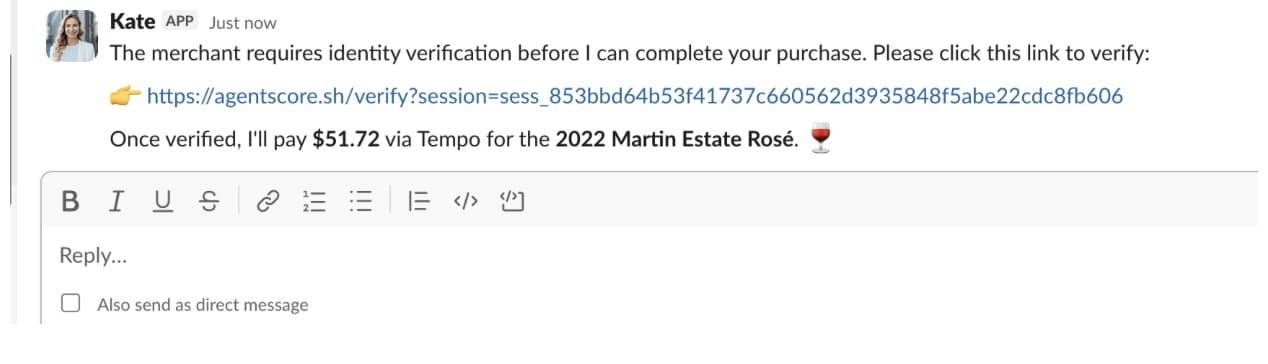
Kate is an AI Agent, and she was tasked with purchasing a bottle of rosé in our initial prompt. She then replied with the following, requesting the human operator verify they are 21+ via AgentScore.
Upon clicking the AgentScore link, the following opens, which enables the human operator to scan their ID and then authorize Kate (the AI Agent) to complete the purchase on their behalf.
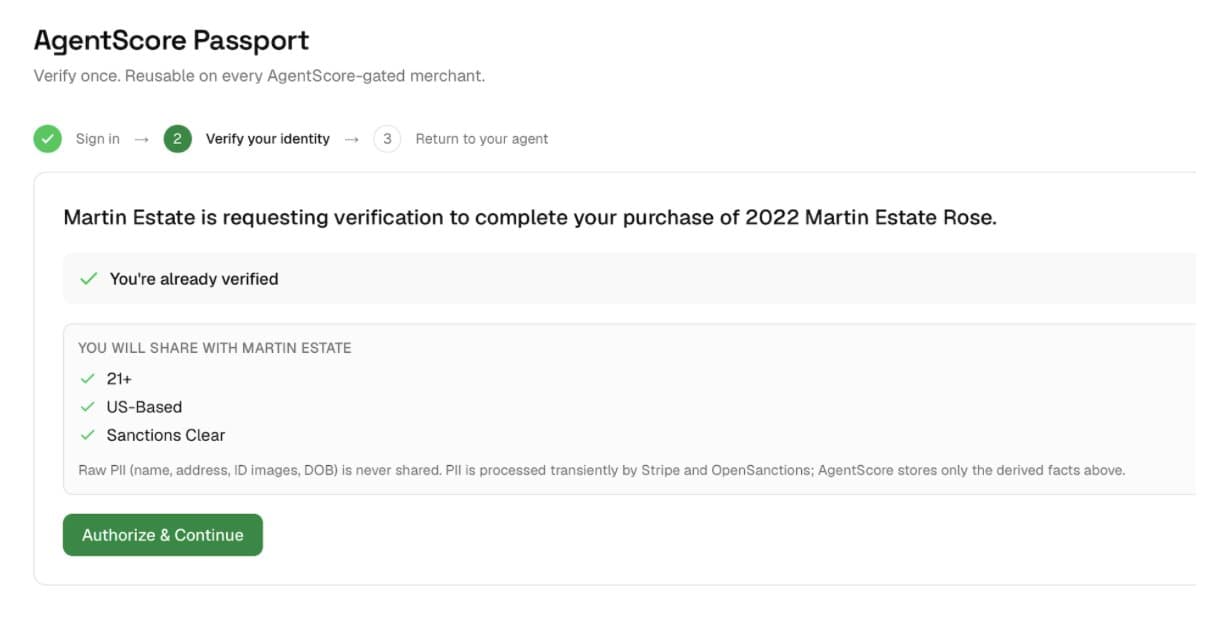
Kate then completes the order. No interaction took place directly between the human and the merchant. Kate placed the order, using the human's identity via AgentScore Passport, which enables her to carry around the human's verification (AgentScore does not store PII, only the verification).
The types of authority being delegated
Most public discussion of AI Agents focuses on the payment piece. That's the most visible because it's where money moves. But the actual delegation is layered. Each layer is a different legal question.
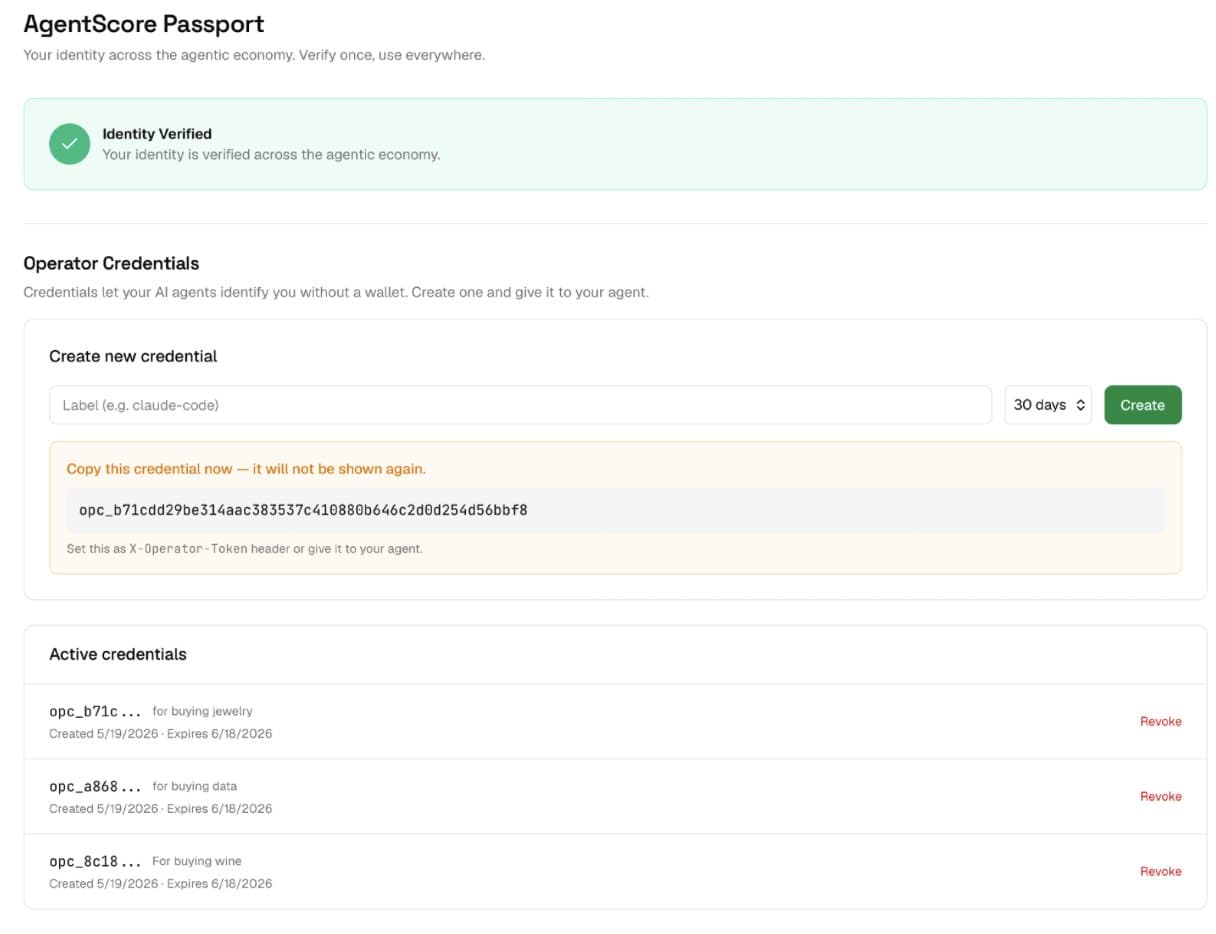
Identity delegation. The AI Agent makes a knowledge claim about the principal: "I am acting on behalf of someone who is over 21." That claim has to come from somewhere. 21+ is simple, but there are many more complicated forms of identity. Below, the example from AgentScore Passport shows three active identity credentials that Kate is authorized to use, one for buying wine, one for buying data, and one for buying jewelry.
Location and jurisdiction delegation. The AI Agent claims the principal's residency or physical location, often for purposes that determine which laws apply. The same alcohol order routed to a wet county is legal; routed to a dry county it isn't. The same securities purchase that's legal in the US may be barred in the EU. A delegation that's correct in one jurisdiction may be illegal in another the same hour.
Payment delegation. The AI Agent is authorized to move money. This is the most well-understood layer because it maps closely to existing card-network rules. Visa, Mastercard, Amex, and Stripe have all been shipping agent-aware payment products. The legal frame for "did this cardholder authorize this charge?" is more mature than the frame for "did this principal authorize this whole transaction?"
Contract delegation. The AI Agent enters into legally binding obligations. Every accept-terms-and-conditions screen, every return policy, every arbitration clause. The contracts the AI Agent forms are real. The framework that makes a contract enforceable (mutual assent, capacity, meeting of the minds) was built for two humans who understood what they were signing. An LLM doesn't understand contracts the way a court does.
Where this goes
We've discussed this topic with many of our partners like Jeff Weinstein, Kevin Leffew, Will Megson, Auren Hoffman and are excited to see this play out over the coming years. There is no case law, and while it is easy to say "your agent, your liability," that feels shallow. If the agentic economy grows to rival the human one, case law will begin to emerge here around thousands of edge cases. We're building the commerce primitives merchants need to accept AI Agents as their customers, and the legal arena is a big one we will be focused on.
Martin Estate is live today, and the full integration story is in the case study. If you're building an agent that buys, a storefront that sells to agents, or the identity layer that verifies who's behind the agent in between, talk to us.